WP4
The Modernised Industry
Industrial architecture, technologies, and systems of production.
Contributors

Dr Rebecca Jane McConnell :Research Scientist

Professor Gary A. Boyd :Principal Investigator
Overview
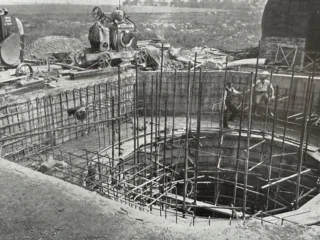
This work package explores the programmes of modernisations that took place in the European coalmining industry in the middle decades of the twentieth century. During this period coalmining was considered critical to the energy necessary to deliver the promise of a new post-war society. It investigates the contexts, physical spaces and forms of the new and often paradigmatically modernistic edifices of coal production – the pits and super-pits, coal-washeries, coking-plants, etc – the spaces where coal was won and processed, as well as aspects of coal consumption and logistics.
With some exceptions, collieries and coal infrastructures usually emerged in the 19th century as unplanned, accretive structures. By the middle decades of the twentieth century, many mines and processing facilities across Europe began to assume more coherent, rational, modernist architectural forms. Much of this responded to technological developments and mechanisation programmes, under the influences of Taylorism and the principles of scientific management. In 1945, for example, the British government published the Reid Report which – based on its assessment of the state of the art in its European and North American equivalents including Belgium, France and Germany (the Ruhr and Silesia) – called for a wholescale spatial reorganisation of the nation’s collieries to increase productivity and efficiency. The work package is particularly interested in how these technologies and spatial systems travelled: how longwall mining, mechanised cutting, powered supports, conveyors, washeries, control rooms and automation produced a recognisable industrial language across different coalfields, even when adopted unevenly and under different political conditions. These and other European initiatives were both expressive of and contributory to wider social, political and spatial contexts.
Radical modernisation programmes – executed from the scale of machinery at the coal face to the development of intra-regional and international infrastructures – of the industry and its social and technological conditions were predicated on coal-mining’s pivotal position as the central means of delivering new social conditions and opportunities to populations, the most conspicuous of which was the construction of the welfare state. But coal’s importance also reached beyond national boundaries. This work packages explores how coal’s rationalised and rationalising architecture and space were pivotal to and expressive of early forms of (western) European integration, beginning in its role in the economic and spatial circumstances of the Benelux Union (1944), and then, more conspicuously, in the Schuman Declaration of 1950 and its realisation of the European Coal and Steel Community.
Other Work Packages
WP1
Settlements and HousingPlanned towns, workers’ housing, and domestic life in coal regions.
WP2
Medical and HygieneHealth infrastructures, welfare provision, and industrial medicineWP3
Education and ExchangeTraining, expertise, and the circulation of knowledge across borders.WP5
Excavating the CoalscapeLandscapes of extraction, infrastructure, and environmental change.